Septic tank crust: how it forms, why it causes damage and how to get rid of it
A septic tank is an essential part of any home that isn’t connected to the public sewer. In everyday use, a crust can form on the surface of the wastewater: a thick, greasy layer floating on top. Many people think it’s normal, but a crust shows that the biological processes in the tank are out of balance, and it’s a sign that you need to act.
In this article you’ll learn what a septic tank crust is, how it forms, why it causes problems and how to get rid of it effectively.
What is a septic tank crust?
The crust (also called the scum layer) is made up mainly of fats, organic residue, proteins, toilet paper and other light fractions of the wastewater that float to the surface. Over time it thickens, sticks together into ever larger clumps and can form a solid lid that hampers or even stops the tank from working properly.
How does a crust form?
A crust forms when undigested organic matter builds up, especially animal and vegetable fats. The factors that encourage it are:
- Too much grease from the kitchen: cooking oil, leftovers from the frying pan and soups poured down the sink.
- Too few bacteria in the tank: bacteria naturally break down fats, but their population may not be big enough.
- Harsh chemicals: detergents and chlorine cleaning products kill the useful microorganisms.
- Desludging too rarely: excess deposits, together with fresh wastewater, speed up crust formation.
Why is a crust a problem?
A crust isn’t just unsightly. It affects how the whole system works:
- It limits the oxygen supply, which favours putrefying bacteria and the formation of hydrogen sulphide.
- It disrupts the separation of layers in the tank: instead of a clear split into sludge, liquid and a light fraction, the layers start to mix.
- It blocks outlets and filters: pieces of crust can break away and settle in pipes or secondary settlement chambers.
- It speeds up clogging of the percolation area: fats can be pushed into the infiltration system and block it.
- The tank needs desludging more often, so maintenance costs go up.
How to recognise a crust in your septic tank
If you spot the problem early, you avoid more serious consequences. A crust can be recognised by a few typical signs, even before it leads to a breakdown.
Visible signs
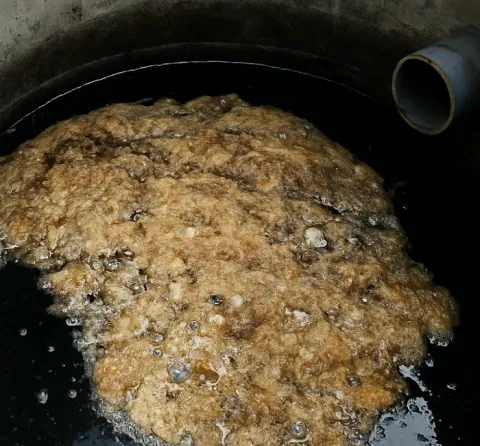
The simplest thing is to look inside the tank. When you lift the lid, you should see the surface of the wastewater. If you can see a thick, grey-brown layer that looks like butter or lard, that’s the crust. At an advanced stage it can look like a solid lid, anything from a few millimetres to 10–15 centimetres thick.
A crust has an uneven, lumpy structure, a grey-white or cream colour, sometimes yellowish, and a greasy consistency. In some cases it looks like foam or a sponge, depending on the make-up of the wastewater and how advanced the problem is.
The stick test
If you’re not sure that what you see is a crust, do a simple test. Take a long stick and press gently on the surface layer. A crust is springy, greasy to the touch and doesn’t break easily, unlike natural foam or deposits, which scatter at the slightest touch.
You can also check how thick the layer is: push the stick straight down through the crust until you reach liquid. If the layer is more than 3–4 centimetres thick, the problem needs dealing with straight away. Under 2 centimetres is an early stage that you can keep under control fairly easily with biological products.
The smell
A strong smell of putrefaction, of hydrogen sulphide (like rotten eggs), coming from the inspection chamber is another clear signal. The crust limits the oxygen supply to the wastewater, and that encourages putrefaction and anaerobic fermentation. If you can smell it not only at the open lid but also in the house (especially in the bathroom or at the drains), the problem is already serious.
Drainage problems
If water drains slowly from sinks, the bath or the toilet, the crust may already have reached the pipework. If at the same time you hear gurgling in the pipes when you flush, the drainage is being held up by built-up fats.
More frequent desludging
If you notice the tank needs emptying much more often than before (for example every 2–3 months instead of every 6 months), the crust may be reducing the working volume of the tank. The layer of fat takes up the space where the wastewater should be, so the tank fills up faster.
How to prevent a crust forming
Prevention is the most effective method. A few basic rules:
- Don’t pour grease down the drain. Collect leftovers from the frying pan in a container and put them in the general waste bin.
- Avoid too many chemicals. Use less bleach, detergent and disinfectant.
- Use biological products. Products with bacteria and enzymes break down fats and organic matter.
- Use lipolytic enzymes regularly. These specialised enzymes break up the structure of fats and make them easier to biodegrade.
- Check the condition of the tank. If you look into the tank from time to time, you’ll spot unwanted changes early.
Biological solutions and how well they work
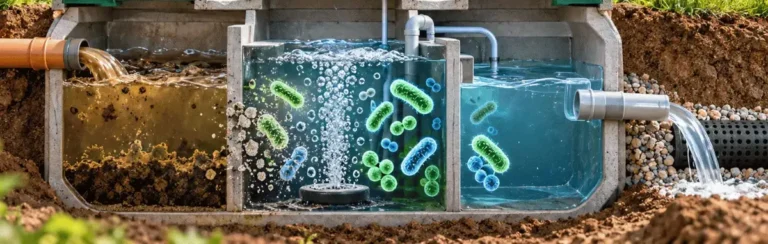
The most effective ways of removing a crust rely on the controlled activity of microorganisms that break down fats. This is done with products containing enzymes and bacteria: lipases and lipolytic bacteria.
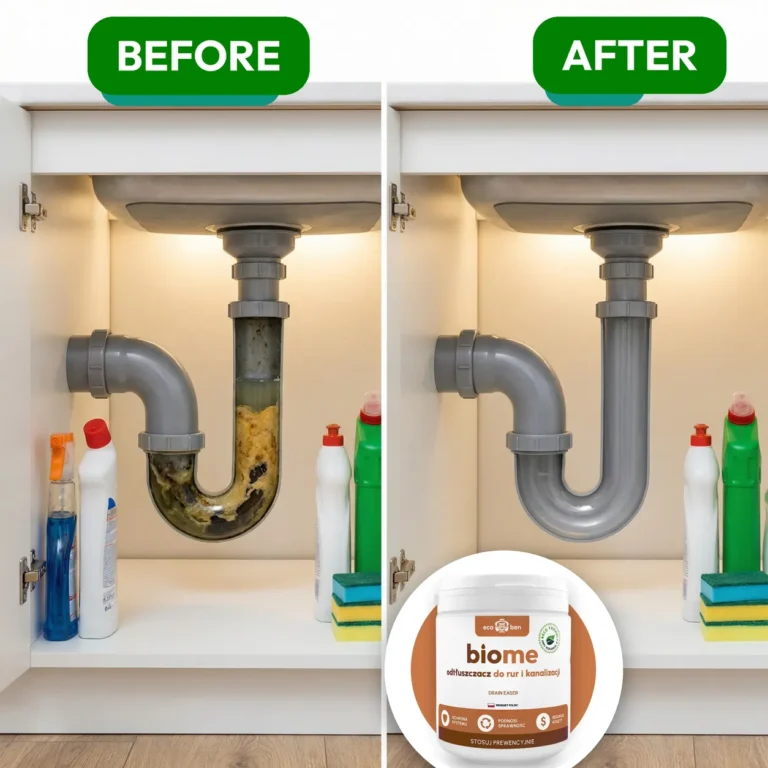
For example, BioMe Drain Easer contains lipolytic enzymes that break the bonds in fat molecules, making it easier for bacteria to break them down further. Used as recommended by the manufacturer, it not only removes the crust but also limits it from forming again. Each 20 g dose contains Bacillus bacteria and five enzymes. Pour the dose into the sink, washbasin or toilet in the evening and rinse through with 2–3 litres of warm water (30–40°C, not boiling). For prevention, one scoop (20 g) every 7–10 days is enough; for treatment, use two scoops (40 g) a day for 1–3 days.
When the biological balance in the tank is already upset, it’s a good idea to top up the bacteria with a seeding product such as BioMe Septic Tank Balance, poured down the toilet once a week.
A septic tank crust isn’t just a cosmetic problem but a real risk to the efficiency of the whole system. It shows that active bacteria are missing, that too much fat is getting into the tank and that the tank isn’t being used properly. The most effective solution is a biological one, with specialised products containing enzymes and bacteria, combined with good prevention. Instead of mechanical and chemical methods, it’s worth choosing natural solutions that tackle the cause of the problem and protect the environment.
When to call in a professional
You can solve most crust problems yourself with biological products. There are, however, situations where professional help is needed or speeds things up considerably.
The tank is completely blocked
If the tank is completely blocked and wastewater is backing up into the house or overflowing from the chamber, it’s an emergency. Don’t wait for biological products to work: call a desludging contractor to remove the crust mechanically and empty the tank. Only after this clean-out can you restore the bacteria biologically.
The crust is over 10 centimetres thick
Bacteria may need weeks to break down a very thick layer of fat. In this case, it’s worth asking a professional to remove part of the top layer mechanically, then finishing the job with biological products. This combined approach is often the most efficient in terms of time and cost.
No result after 4–6 weeks of biological products
If you’ve been using the products regularly for more than a month and the crust hasn’t reduced at all, the cause may be:
- conditions in the tank that stop the bacteria working (extreme temperature, toxic substances);
- an unusual chemical make-up of the crust that calls for specialised enzymes;
- a deeper problem, for example a damaged tank or faulty construction.
In this situation, get advice from a company that specialises in septic tank maintenance and can carry out a thorough diagnosis.
A smell of hydrogen sulphide in the house
If the strong smell of putrefaction reaches the house (not just at the open lid), gases from the tank are getting through the pipework. The causes may be:
- damaged traps that have lost their water seal;
- cracks in the pipes;
- too much gas pressure in the tank.
This is a job for a plumber, who can find the source of the problem and seal it.
The tank freezes in winter
In winter, especially in very low temperatures and when little water is being used, a septic tank can partly freeze. The crust hardens and becomes even harder to remove. Below 5°C, biological products practically stop working. In this situation you need a professional who can:
- remove the frozen layer mechanically;
- warm the tank up properly;
- advise you on how to prevent freezing in future.
Signs the tank is damaged
Watch out if, during an inspection, you notice:
- cracks in the tank walls;
- ground around the tank that is sinking;
- damp soil around the lid;
- chambers filling unevenly (in tanks with several chambers).
These may be signs of a more serious structural problem. In that case the crust is just a side effect, and the main problem needs a building contractor or a specialist in sealing tanks.
Businesses and larger households
If you run a business (for example a B&B, a restaurant or a production site) and have problems with a crust, don’t experiment on your own. Professional diagnosis and servicing of the tank are an investment that prevents interruptions to your business.
When is a preventive check worthwhile?
You don’t have to wait for a breakdown. Septic tanks and treatment systems in Ireland can also be inspected under the EPA’s national inspection programme, and a large share of the systems inspected fail, often because of poor maintenance. Book an inspection with a desludging contractor or a domestic wastewater specialist if:
- you haven’t emptied the tank for more than 2 years;
- you’ve just bought the house and don’t know the tank’s history;
- you’re planning to switch from a septic tank to a biological treatment system;
- you have doubts about whether the system is working properly.
The most important rules
- Don’t combine biological products with chlorine, bleach or antibacterial products.
- Use the products regularly, not just once.
- Be patient: results show after 2–4 weeks, not 2 days.
- Temperature matters: below 10°C, biological processes slow down a lot.