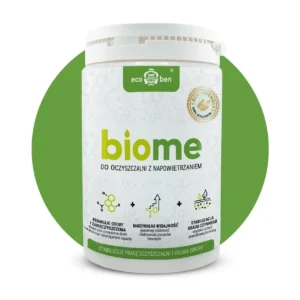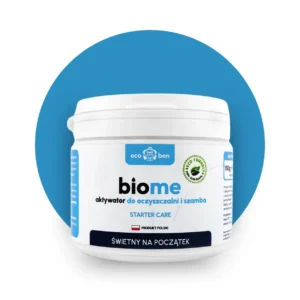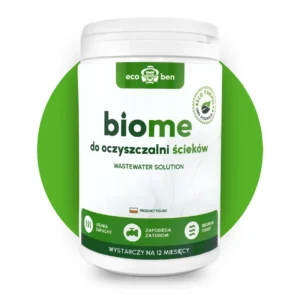
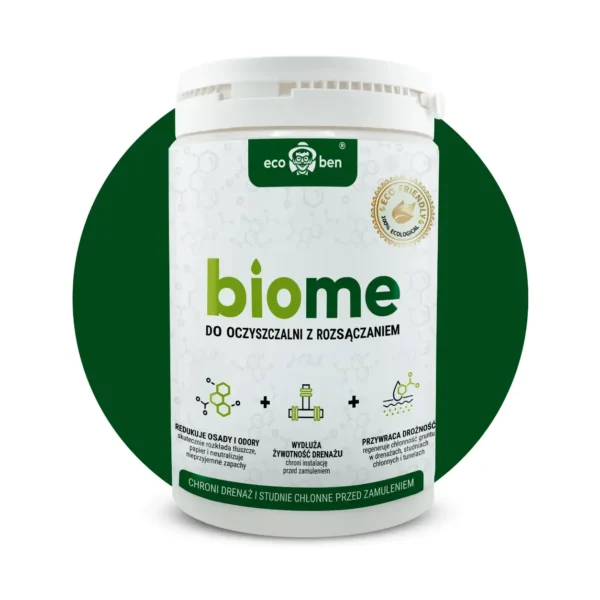
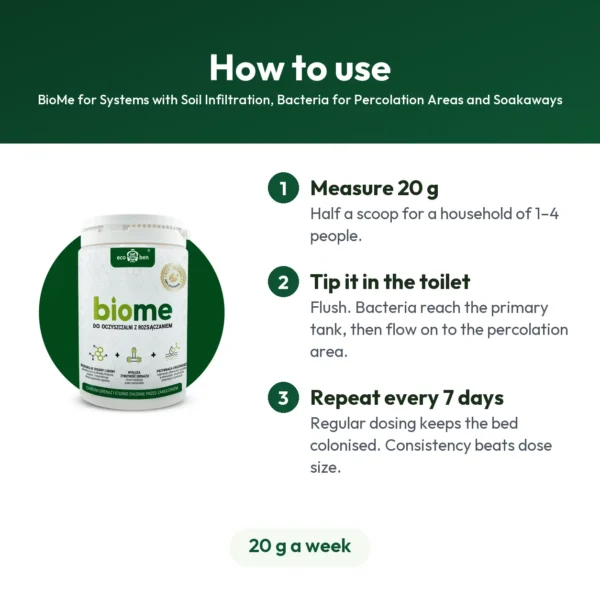
BioMe for Systems with Soil Infiltration, Bacteria for Percolation Areas and Soakaways
Bioactivator for treatment systems with soil infiltration: a percolation area, soakaway or infiltration tunnels. Bacillus bacteria and five enzymes break down the deposits that clog the soil and restore its ability to soak up water.
- Protects the percolation area: prevents the soil pores clogging
- Fewer odours around the system and in the garden
- Down the toilet, 20 g once a week
Looking for this product for your business?
We sell wholesale, to distributors and under your own brand. Tell us what you need and we will prepare an offer.
Request a wholesale offer- Manufacturer with its own laboratory
- Wholesale, private label, distribution
- Shipping from Poland across Europe
- Prevents cloggingProtects the soil pores around the percolation area and soakaway
- 5 active enzymesBreak down fats, paper, proteins and starch
- Fewer odoursLess smell around the system and in the garden
- 20 g a weekDown the toilet, no lifting the lid or digging
Percolation areas don’t block overnight. They clog up year after year.
For treatment systems where the treated water soaks into the soil: a percolation area, a soakaway or infiltration tunnels. Bacillus bacteria and five enzymes break down the fats, paper and organic deposits that block the pores in the soil. You pour the dose down the toilet once a week.
- Percolation area and soakawayand infiltration tunnels
- 5 active enzymesfor fats, proteins, starch and paper
- pH 5–8safe for PVC and PE pipes, seals and concrete
- 500 g or 1 kg25 or 50 weekly doses
Water soaks away more and more slowly and damp patches appear
Fats, toilet paper and organic deposits gradually form a film that blocks the pores in the soil around the percolation pipes. This is called clogging, and it is the most common reason systems with soil infiltration fail.
- Water leaves the treatment system more and more slowly
- Damp patches and greener grass above the percolation area
- An unpleasant smell around the system and in the garden
- Water backs up into the distribution box
Once a percolation area is fully blocked, the usual options are jetting the pipes or replacing the percolation bed, with the garden dug up. Biological prevention costs you far less than an emergency repair.
Fresh bacteria from the primary tank to the percolation area
Measure 20 g
Half a scoop for a household of 1–4 people.
Tip it in the toilet
Flush. Bacteria reach the primary tank, then flow on to the percolation area.
Repeat every 7 days
Regular dosing keeps the bed colonised. Consistency beats dose size.
Choose your dose by the number of people
Standard dose
- 1–4 people
- 20 g (½ scoop)
- 5–9 people
- 40 g (1 scoop)
- 10–15 people
- 80 g (2 scoops)
- How often
- every 7 days
Intensive dose
- Dose
- double the standard dose
- How often
- every 7 days for 2–3 weeks
- Then
- the standard dose
Use the intensive dose on first use, after a long break or at the first signs of clogging (water drains more slowly, damp patches). Pick a fixed day of the week; the time of day doesn’t matter.
Don’t pour chlorine, bleach, chemical unblockers, caustic soda or acids into the system. Condensate from a condensing boiler (pH approx. 3–4) and brine from a water softener also hold the bacteria back. After a chemical incident, wait at least 48 hours before the next dose.
What this product won’t do
It won’t clear a fully blocked percolation area
If water is already surfacing, the pipes need jetting or BioMe Drain Unblocker. After that, use this product for prevention.
It won’t break down sand and gravel
Bacteria only break down organic matter. Mineral deposits, broken pipes or a cracked primary tank can’t be fixed biologically.
It won’t work instantly
The bacteria need a few weeks to build a stable population in the percolation bed.
What our customers ask
Which systems is this product for?
For treatment systems where the treated water soaks into the soil: a percolation area, a soakaway or infiltration tunnels. For aerated systems (SBR, activated sludge) we have BioMe SBR Booster, and for septic tanks BioMe Septic Tank Balance.
How is it different from BioMe Wastewater Solution?
Wastewater Solution supports the activated sludge in a treatment system in general. This product is made for systems with soil infiltration: its main job is to protect the soil pores around the percolation area and the soakaway from clogging.
I have a primary tank before the percolation area. Do I need another product for it?
No. The product works both in the primary tank and in the percolation bed. From the toilet it reaches the primary tank first, where the bacteria start breaking down deposits, then flows on with the water to the percolation area.
My percolation area is already clogging. Will it help?
In the early stage (water drains more slowly, damp patches, greener grass above the pipes), yes: use the intensive dose for 2–3 weeks, then the standard dose. If water is already surfacing, the product alone isn’t enough.
When will I see results?
The smell usually eases after 2–3 weeks of regular use. Infiltration improves within 4–8 weeks, depending on how clogged the soil was. These figures are a guide only.
How long does one pack last?
At 20 g a week (1–4 people), 500 g lasts about 25 weeks and 1 kg about 50 weeks. At 40 g a week (5–9 people), half that time.
Everything you need to know
Ingredients
Sodium chloride, Bacillus bacteria (GRAS status), maltodextrin (starter nutrient), enzymes (alpha-amylase, alkaline protease, neutral protease, cellulase, lipase), lemon fragrance, trace elements. Beige-brown granules, pH 5–8, fully water-soluble, fully biodegradable.
Storage
- In the tightly sealed pack, somewhere cool and dry (up to 25°C)
- Away from moisture, heat sources and direct sunlight
- Away from strong oxidisers
- Out of reach of children and pets, away from food
CLP classification and precautions
This product is not classified as hazardous under CLP (EU 1272/2008). EUH208: contains enzymes, may produce an allergic reaction. May irritate skin and eyes; do not swallow. Avoid raising dust when measuring, wear gloves and wash your hands after use.
First aid
- Eyes: rinse with plenty of cold water for about 15 minutes and remove contact lenses.
- Skin: wash with plenty of soap and water.
- Inhalation: get fresh air; if coughing or breathing difficulties occur, see a doctor.
- Swallowing: rinse mouth with plenty of water; if symptoms occur, get medical help. Emergency number: 112 or 999.