
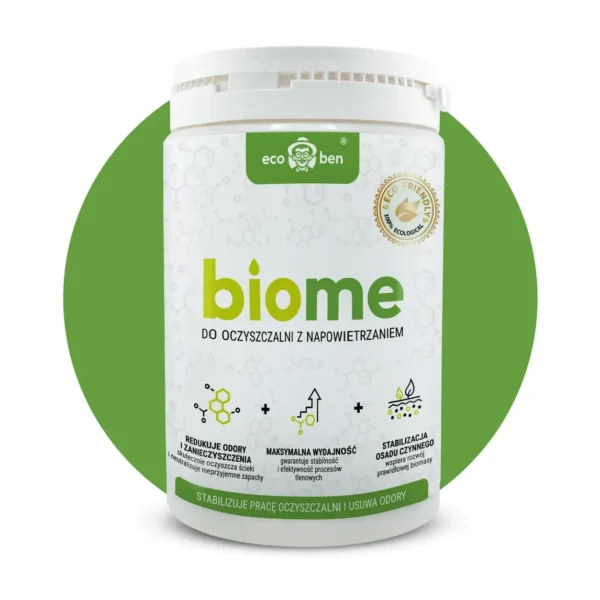
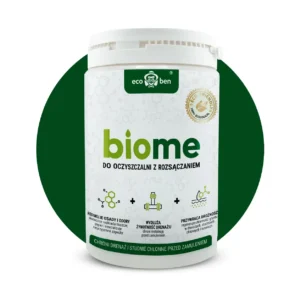
BioMe SBR Booster Bacteria for Aerated Treatment Systems
Bioactivator for aerated treatment systems: SBR, activated sludge or biofilm systems. Bacillus bacteria and five enzymes top up the activated sludge in the aeration chamber, reduce odours and help produce clearer effluent.
- Stable activated sludge, even after chemicals or a holiday
- 5 enzymes for fats, proteins, starch and fibre
- Straight into the aeration chamber: 20 g once a week
Looking for this product for your business?
We sell wholesale, to distributors and under your own brand. Tell us what you need and we will prepare an offer.
Request a wholesale offer- Manufacturer with its own laboratory
- Wholesale, private label, distribution
- Shipping from Poland across Europe
- Stable activated sludgeTops up bacteria weakened by chemicals and antibiotics
- 5 active enzymesBreak down fats, proteins, starch and fibre
- Clearer effluentHelps activated sludge flocs to form
- Fewer odoursSupports nitrification of ammonia in the aeration chamber
An aerated treatment system is a biological reactor. Keep the activated sludge in shape.
For aerated treatment systems: SBR, activated sludge or moving bed biofilm reactor (MBBR). Bacillus bacteria and five enzymes top up the activated sludge in the aeration chamber, reduce odours and help produce clearer effluent. You add the dose once a week, straight into the aeration chamber.
- SBR and activated sludgeand MBBR biofilm systems
- 5 active enzymesfor fats, proteins, starch and fibre
- pH 5–8biodegradable, not classified as hazardous
- 500 g or 1 kg25 or 50 weekly doses
A smell at the lid and cloudy effluent
Chlorine-based cleaners, bleach, antibiotics, long breaks (holidays, a weekend home) and load peaks after visitors weaken the bacteria in the aeration chamber. The activated sludge struggles to break down fats and proteins, and ammonia is no longer properly nitrified.
- A fermentation and ammonia smell at the lid
- Cloudy or grey effluent
- A strong smell when you come back from holiday
- Problems after someone in the house has taken antibiotics
When the bacteria don’t form proper flocs, the sludge doesn’t settle and leaves the system with the clarified water. That puts a burden on the percolation area or the ditch the water discharges to.
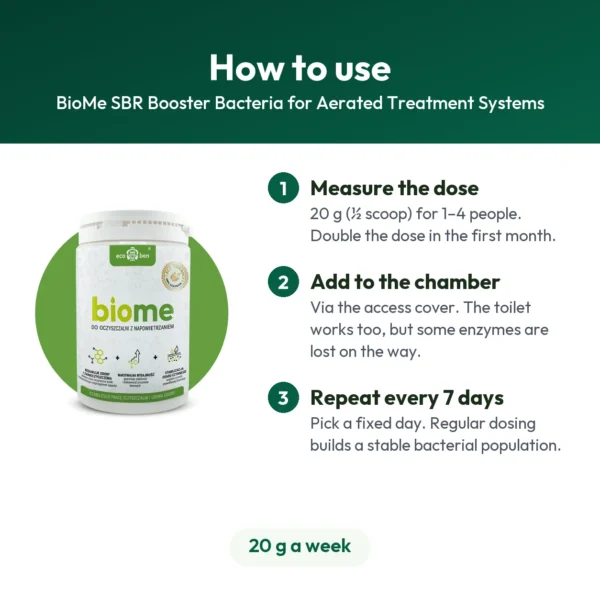
Fresh bacteria straight into the aeration chamber
Measure the dose
20 g (½ scoop) for 1–4 people. Double the dose in the first month.
Add to the chamber
Via the access cover. The toilet works too, but some enzymes are lost on the way.
Repeat every 7 days
Pick a fixed day. Regular dosing builds a stable bacterial population.
A start-up dose in the first month, then a maintenance dose
Maintenance dose
- 1–4 people
- 20 g (½ scoop)
- 5–9 people
- 40 g (1 scoop)
- 10–15 people
- 80 g (2 scoops)
- How often
- every 7 days
Start-up dose
- 1–4 people
- 40 g (1 scoop)
- 5–9 people
- 80 g (2 scoops)
- 10–15 people
- 160 g (4 scoops)
- How often
- every 7 days for 4 weeks
Use the start-up dose on first use, after chemicals or after a holiday. If someone in the house has been on antibiotics, use a double dose for 2–3 weeks after the course ends.
The blower or aeration pump must be running: the bacteria need oxygen. Don’t dose straight after chlorine, bleach, hydrogen peroxide or acid from drain unblockers: wait 24 hours. Gas boiler condensate and water softener brine also hold the bacteria back.
What this product won’t do
It won’t replace the blower
Without aeration the bacteria don’t work. A faulty blower, pump or control unit needs a specialist.
It won’t work without oxygen
It isn’t for septic tanks or anaerobic systems. For a septic tank, use BioMe Septic Tank Balance.
It won’t replace removing excess sludge
Regular desludging is still needed, as set out in the system manufacturer’s instructions.
What our customers ask
Which systems is this product for?
For systems with an aeration chamber: SBR, activated sludge (including continuous flow) or moving bed biofilm (MBBR). For systems with soil infiltration (percolation area, soakaway, tunnels) we have BioMe for systems with soil infiltration, and for septic tanks BioMe Septic Tank Balance.
How is it different from BioMe Wastewater Solution?
Wastewater Solution is dosed down the toilet and supports treatment systems in general, aerobic and anaerobic. SBR Booster is made for aerated systems and is ideally added straight into the aeration chamber, where the activated sludge does its work.
Do I need to open the lid?
We recommend adding the dose straight into the aeration chamber through the access cover: the bacteria go straight into the oxygen-rich environment. Using the toilet is more convenient and does work, but some of the enzymes are used up on the way through the pipes.
When will I see results?
The first results (less smell, clearer effluent) show after 7–14 days of regular use. The activated sludge stabilises within 3–4 weeks. In a system that has been neglected for a long time, results can take 6–8 weeks.
I’ve come back from holiday and the system smells. What should I do?
Use a double dose once a week for 2–4 weeks. Before a long trip away, add a dose just before you leave and another the day after you get back.
How long does one pack last?
At 20 g a week (4 people), 500 g lasts about 25 weeks and 1 kg about 50 weeks. At 40 g a week, 500 g lasts about 12 weeks and 1 kg about 25 weeks.
Everything you need to know
Ingredients
Sodium chloride, Bacillus bacteria (GRAS status), maltodextrin (starter nutrient), enzymes (alpha-amylase, alkaline protease, neutral protease, cellulase, lipase), lemon fragrance, trace elements. Beige-brown powder, pH 5–8, fully water-soluble, fully biodegradable.
Storage
- In the tightly sealed pack, somewhere cool and dry (up to 25°C)
- Away from moisture, heat sources and direct sunlight
- Away from strong oxidisers
- Out of reach of children and pets, away from food
CLP classification and precautions
This product is not classified as hazardous under CLP (EU 1272/2008). EUH208: contains enzymes, may produce an allergic reaction. May irritate skin and eyes; inhaled dust may cause allergy or asthma symptoms. Avoid raising dust when measuring, wear gloves, ventilate the room and wash your hands after use.
First aid
- Eyes: rinse with plenty of cold water for about 15 minutes and remove contact lenses.
- Skin: wash with plenty of soap and water.
- Inhalation: get fresh air; if symptoms occur, see a doctor.
- Swallowing: rinse mouth with plenty of water; if symptoms occur, get medical help. Emergency number: 112 or 999.
Related products
-
BioMe Crust Reducer, Treatment for Fat Crust in Septic Tanks 300 g
View product -

BioMe Septic Tank Balance Bacteria for Septic Tanks
View product -
BioMe Wastewater Solution Bacteria for Treatment Systems
View product -
BioMe for Systems with Soil Infiltration, Bacteria for Percolation Areas and Soakaways
View product