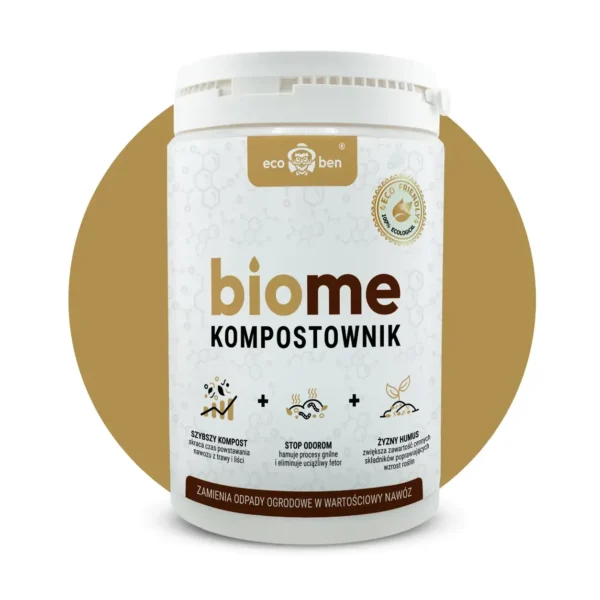
BioMe Compost Activator, Biological Compost Accelerator 250 g
Biological compost activator. Lactic acid bacteria and Bacillus, with 4 groups of enzymes, break down grass, leaves and kitchen scraps and shorten the time your heap takes to mature.
- Compost in 3–4 months instead of 10–18
- No smell of rotting: controlled fermentation
- Simple: about 10 g per m² on every new layer
Looking for this product for your business?
We sell wholesale, to distributors and under your own brand. Tell us what you need and we will prepare an offer.
Request a wholesale offer- Manufacturer with its own laboratory
- Wholesale, private label, distribution
- Shipping from Poland across Europe
- Compost in 3–4 monthsInstead of 10–18 months in a heap without an activator
- Bacteria + 4 enzymesCellulase, proteases, amylase and lipase for plant waste
- No nasty smellControlled fermentation instead of rotting
- Even compostA uniform structure and more humus for your plants
Compost ready in 3–4 months. Not 10–18.
Lactic acid bacteria and Bacillus, with four groups of enzymes, that speed up the breakdown of garden and kitchen waste. The heap works without any smell of rotting, and the finished compost comes out even and crumbly.
- 3–4 monthsinstead of 10–18 months without an activator
- Bacteria + 4 enzymescellulase, proteases, amylase, lipase
- No nasty smellcontrolled fermentation instead of rotting
- 250 gfor about 3 m³ of compost
The compost heap just sits there and smells
Composting is a microbiological process. There usually aren’t enough natural microbes in the waste to work quickly, which is why an ordinary heap takes 10–18 months.
- A smell of rotting, especially in the warmer months
- You can still see undecomposed bits in the compost
- Weeds from the compost sprout in your beds
- The heap takes up space in the garden for months
In a cold heap, weed seeds and plant diseases survive. An active heap heats up inside and holds them back.
Enzymes first, then bacteria
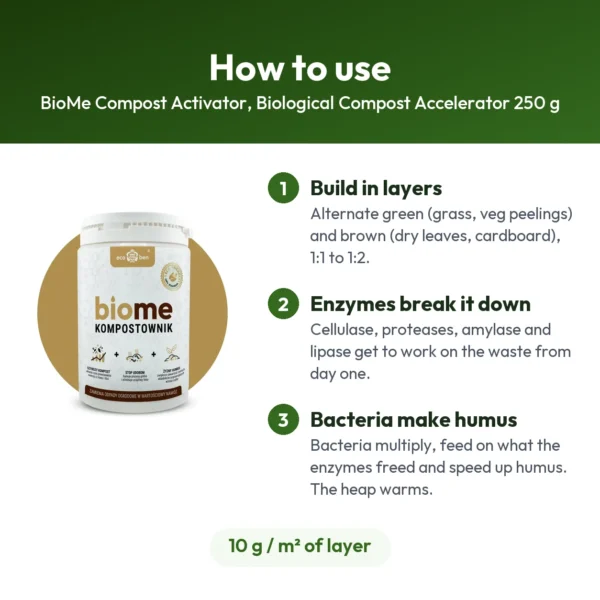
Build in layers
Alternate green (grass, veg peelings) and brown (dry leaves, cardboard), 1:1 to 1:2.
Enzymes break it down
Cellulase, proteases, amylase and lipase get to work on the waste from day one.
Bacteria make humus
Bacteria multiply, feed on what the enzymes freed and speed up humus. The heap warms.
A little on every new layer
Each layer
- Dose
- approx. 10 g (1 tablespoon) per m²
- When
- every 20–30 cm of material
- Moisture
- 40–60%
When turning
- How often
- every 2–4 weeks
- Dose
- an extra dose over the spread-out heap
- In spring
- turn and sprinkle again
The right moisture: like a wrung-out sponge. Water the heap when it’s dry. The first sign the activator is working: after 2–3 days the heap is warm inside, and on cool mornings you may see steam. If it’s still cold after 3–4 days, check the moisture and the green/brown ratio.
Don’t combine with slaked lime, chlorine products, disinfectants or fungicides: they kill the bacteria. If you’ve used lime, mix the heap well and wait 2–3 days. Don’t dissolve the product in boiling water: above 50°C the bacteria lose their activity.
What this product won’t do
It doesn’t work the same in winter
In winter the process slows down. In spring, once it’s above 10°C outside, turn the heap and sprinkle again.
It won’t compost everything
Meat, bones, fish, fats, dairy, dog and cat waste and diseased plants don’t belong on the compost heap.
It won’t replace air and water
Without turning every 2–4 weeks and the right moisture, the bacteria can’t do their job.
What our customers ask
What can I put on the compost?
Kitchen scraps (peelings, coffee grounds, plastic-free tea bags), grass clippings in thin layers, leaves, chopped twigs, healthy garden waste, uncoated paper and cardboard without colour printing, and weeds before they set seed. Citrus peel breaks down slowly, and walnut shells release juglone, which is toxic to some plants.
When will I see results?
The first signs (a warm heap, less smell) appear after 2–3 days. The structure breaks down visibly after 3–4 weeks. The compost is ready after 3–4 months, as long as you keep it moist and turn it regularly. Results depend on the mix of materials, the moisture and how often you turn it.
The heap smells bad. What should I do?
A smell means a lack of oxygen. If it’s too wet, add brown material (dry leaves, cardboard, straw) and turn it well. If there’s too much grass, mix it with brown material. After 2–3 days the smell usually becomes a light, earthy one.
How can I tell when the compost is ready?
Dark brown, almost black, with the smell of forest soil, a fine, even, crumbly structure, no visible scraps and cool to the touch. You can use it straight away on vegetable beds, around trees or in pots.
Does it work in a small compost bin?
Yes, but bins under 1 m³ may not reach as high an internal temperature as large heaps. The activator helps there too, but the sanitising effect of the heat may be weaker.
Everything you need to know
Ingredients
Non-pathogenic bacteria (lactic acid bacteria and Bacillus) and 4 groups of immobilised enzymes: cellulase, proteases (neutral and alkaline), amylase, lipase. Powder to sprinkle or dissolve in water. 100% biodegradable.
Storage
- In the tightly closed pack, somewhere dry (moisture activates the bacteria too early)
- At no more than 25°C, out of direct sunlight
- Away from disinfectants, chlorine and lime
- Out of reach of children
CLP classification and precautions
This product is not classified as hazardous under CLP (EU 1272/2008). Contains non-pathogenic microorganisms and enzymes: may produce an allergic reaction in people sensitive to enzymes. Keep out of reach of children. Avoid breathing in the dust when sprinkling and avoid contact with eyes. Not for consumption.
First aid
- Eyes: rinse with water for several minutes.
- If swallowed accidentally: contact a doctor immediately. Emergency number: 112 or 999.